

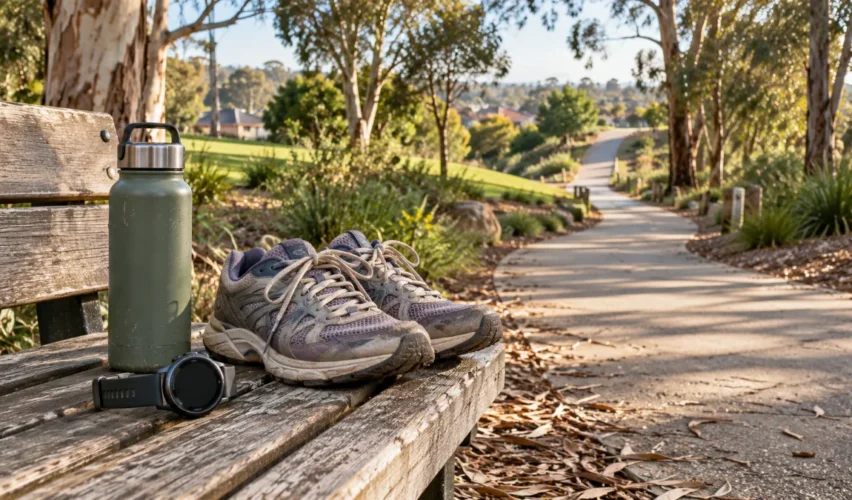
A step counter tells you how much you have walked, but it does not tell you how hard that walking felt. A day of gentle movement and a shorter, brisk walk can contribute to your activity in different ways.
When comparing walking pace vs step count, both have a role. Step count helps you monitor your overall movement, while walking at an appropriate effort level can help you challenge and improve your cardiovascular fitness.
The useful question is how to combine regular movement, suitable intensity and a routine you can maintain.
What daily step numbers can tell you
Your daily step count provides a simple picture of how much walking you accumulate. It includes purposeful walks and everyday movement, such as walking to public transport, shopping or moving around at work.
Tracking your usual total can help you identify less active days and find opportunities to move more. However, the number alone does not describe your walking effort, time spent sitting or activities such as swimming and cycling.
| Measure | What it helps you understand | What it cannot show on its own |
|---|---|---|
| Daily steps | How much walking you accumulate | How challenging that walking feels |
| Walking pace | How quickly you cover a distance | How hard you are working relative to your ability |
| Walking time and effort | How long you spend walking at a particular intensity | Your complete activity pattern across the day |
You do not need to begin with 10,000 steps
There is no universal requirement to reach 10,000 steps before walking becomes worthwhile.
A 2025 systematic review published in The Lancet Public Health found that higher daily step counts were associated with better outcomes across several measures of health. Around 7,000 daily steps was associated with meaningful benefits compared with 2,000 steps.
These findings do not establish a compulsory target or guarantee an individual outcome. The evidence was observational, and differences in health and lifestyle can influence the results.
For someone who currently walks very little, a manageable increase from their usual activity may be a more practical starting point than immediately chasing a large total.
Brisk walking and effort levels
Walking pace matters because increasing your effort can turn an everyday stroll into moderate-intensity activity. However, the speed needed to reach that intensity differs between people.
Your fitness, mobility, the terrain and other factors influence how demanding a walk feels. A pace that feels easy for one person may be challenging for someone else.
Use the talk test
The talk test offers a practical way to judge your effort without needing a particular speed on your watch.
During moderate-intensity walking:
- Your breathing and heart rate increase.
- You can still talk in sentences.
- Singing comfortably becomes difficult.
You do not need to become exhausted or gasp for air to benefit. If the effort feels excessive, slow down.
A hill can also make a familiar pace more demanding. This is why comparing kilometres per hour between different routes or different people can be misleading.
Consider minutes as well as steps
Australia’s current guidelines for adults aged 18 to 64 recommend moderate- to vigorous-intensity activity for 30 minutes or more on most days. They also recommend light movement throughout the day and regularly breaking up prolonged sitting.
A high step total does not automatically confirm that you have completed moderate-intensity activity. Equally, a day with fewer steps may still include a purposeful walk that raises your breathing and heart rate.
For practical tracking, record both your total movement and the time you spend walking at a suitable effort. Count the moderate-intensity portions of a walk when assessing those minutes, rather than assuming every minute was brisk.
Building a walking routine
A useful walking routine fits your starting point and gives you room to progress. You do not need to increase your speed, distance and step target at the same time.
Establish your starting point
For several ordinary days, notice:
- How much walking you already do.
- How long you can walk comfortably.
- Whether your usual walks feel easy or moderately challenging.
- Which times and routes are easiest to repeat.
If you use a phone or watch, carry or wear it consistently when comparing your own activity over time. You can also track minutes and completed walks without using a step counter.
Build consistency before adding difficulty
Choose a realistic opportunity, such as a short walk after breakfast or during a lunch break. If you are starting from little activity, a short, comfortable session may be enough initially.
Once that feels manageable, gradually extend the walk or include short brisk sections. For example, someone already comfortable walking could alternate a brief period at a moderately challenging pace with easier walking.
Treat this as an option to adapt, rather than a fixed programme everyone must follow. Increase one element at a time and adjust if the change causes pain or excessive fatigue.
Make the routine easier to maintain
Begin and finish your walks at an easier pace. Choose comfortable, supportive footwear and a route suited to your ability.
In Australian conditions, consider the weather, shade, water and sun protection. An indoor route may be more practical during extreme heat or unsuitable weather.
Walking with a friend or choosing a familiar local circuit can also make regular activity easier to organise.
Include other types of movement
Walking is one part of a broader fitness routine. Australian adult guidelines also recommend:
- Muscle-strengthening activities on at least two days each week.
- Activities targeting mobility, balance and coordination on at least three days each week.
A step target should support these activities, rather than encourage you to leave them out because they do not add many steps.
Adapting for mobility and health
Walking goals should reflect your abilities and health needs. There is little value in chasing a pace or daily total that makes you less steady, increases pain or discourages you from moving.
Possible adjustments include:
- Taking shorter walks with opportunities to rest.
- Choosing level, accessible paths.
- Using a prescribed walking aid.
- Walking with someone who matches your pace.
- Tracking comfortable activity time instead of steps.
Australian guidance for people with disability recommends starting slowly and building activity where possible, with professional support when needed.
If walking is limited, a physiotherapist or accredited exercise physiologist can help identify suitable alternatives and ways to work towards your goals.
Seek individual advice if a medical condition, recent operation, persistent pain or balance problem affects your walking. Stop exercising and seek medical assessment if you develop new symptoms such as chest pain, dizziness or unusual breathlessness. Severe symptoms require urgent medical attention.
Conclusion
Walking pace and step count answer different questions. Steps help you monitor how much you move, while effort and walking time help you understand how much of that movement challenges your fitness.
Start with an achievable routine, build gradually and include brisk walking when appropriate for your ability. Combine walking with strength, balance and mobility activities, and use tracking tools to support progress rather than judge every day against one number.
Frequently asked questions
Is slow walking still worthwhile?
Yes. Slower walking adds movement to your day and can help replace time spent sitting. It may also feel moderately challenging for some people. Its value should not be dismissed simply because someone else walks faster.
Is there one walking speed everyone should aim for?
No. The same speed can produce different effort levels depending on fitness, mobility and the route. The talk test can help you judge your own effort, while a health professional can provide guidance where needed.
Should I increase my steps or my pace first?
If you currently move very little, begin by establishing a comfortable, repeatable routine. As that becomes manageable, gradually add time or short brisk sections. Your starting point and health needs should guide the order.
Sources
- Australian Government: Recommendations for adults aged 18 to 64. Covers activity intensity, strengthening, balance and reducing sedentary time.
- Ding and colleagues: Daily steps and health outcomes in adults, 2025. A systematic review and dose-response meta-analysis examining associations between daily steps and health outcomes.
- Better Health Channel: Walking for good health. Explains brisk walking, the talk test and practical walking habits.
- Better Health Channel: Physical activity, how to get started. Covers starting gently, setting goals and progressing activity gradually.
- Australian Government: Recommendations for people with disability. Includes guidance on adapting activity and seeking professional support.
- Better Health Channel: Walking, safety and environmental issues. Covers route selection, footwear, hydration and sun protection.
- Better Health Channel: Walking, the benefits for older people. Discusses walking aids, individual health needs and symptoms requiring assessment.