

Why Building Structures Matter
Have you ever looked at a skyscraper in Sydney or a weatherboard home in regional Victoria and thought, “How on earth do they stay standing?” Well, the answer lies in building structures—the frameworks and systems that give strength, shape, and safety to everything we live and work in.
Understanding the different types of building structures isn’t just for engineers. For homeowners, developers, or even curious readers, knowing the basics helps you make smarter choices about safety, cost, sustainability, and design. Plus, it’s fun to know why bridges don’t wobble (well, most of the time) and why some houses handle Aussie weather better than others.
In this post, we’ll walk you through the main types of building structures, their features, pros and cons, and how they’re used in Australia today.
Snapshot Summary: Key Takeaways
Here’s a quick “cheat sheet” of what you’ll learn:
- Building structures are the backbone of safety, stability, and design.
- Types include load-bearing, framed, truss, shell, and composite structures.
- Each type has unique uses, from suburban homes to high-rise towers.
- Sustainability and technology are reshaping structural design in Australia.
- Choosing the right structure depends on cost, purpose, and environment.
Want to dive deeper into the structures that shape our world? Keep reading.
1. Load-Bearing Structures
This is the oldest and simplest type of building structure. In a load-bearing design, the walls carry the entire weight of the building and transfer it to the foundation.
Common Uses in Australia:
- Older homes and small residential projects.
- Rural areas where materials like brick or stone are abundant.
Pros:
- Simple and durable.
- Low construction cost.
Cons:
- Thick walls reduce usable space.
- Not practical for high-rise buildings.
Pro Tip: If your walls are thick enough to hide a secret room, chances are you’re living in a load-bearing structure.
2. Framed Structures
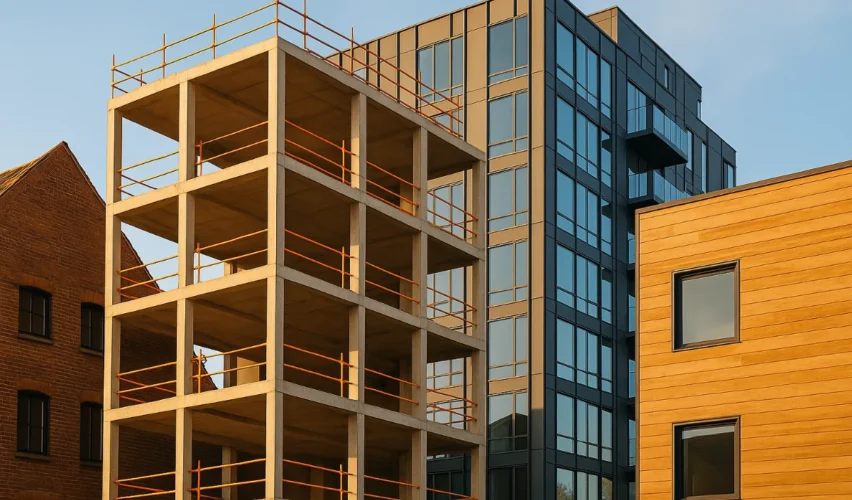
In this type, the load is carried by a framework of beams and columns rather than walls. This is the go-to for modern construction.
Examples:
- Steel or reinforced concrete frames in skyscrapers and office buildings.
Pros:
- Allows flexible floor plans and large open spaces.
- Suitable for high-rise construction.
Cons:
- Requires skilled labour and higher costs.
Did You Know? Almost every new high-rise in Melbourne uses a reinforced concrete frame—it’s the structural “skeleton” of modern cities.
3. Truss Structures
A truss is a structure made of triangular units. It’s widely used in bridges, stadium roofs, and even residential houses.
Australian Examples:
- Roofs of sporting arenas like the MCG.
- Pedestrian and railway bridges.
Pros:
- Strong yet lightweight.
- Economical for long spans.
Cons:
- Design complexity.
- Requires precision in assembly.
4. Shell Structures
Shell structures use curved surfaces (like domes or vaults) to support loads.
Uses:
- Auditoriums, stadiums, and modern airports.
- Sustainable housing projects with unique designs.
Pros:
- Efficient in distributing loads.
- Aesthetic and futuristic.
Cons:
- Expensive construction techniques.
- Limited local expertise.
Humour break: Shell structures are a bit like eggs—lightweight yet surprisingly strong, unless someone drops them.
5. Composite Structures
These combine two or more materials (like steel and concrete) to optimise strength and durability.
Australian Use:
- Bridges, skyscrapers, and advanced infrastructure.
Pros:
- Maximum strength and flexibility.
- More sustainable with the right materials.
Cons:
- Higher design and maintenance costs.
6. Timber Structures
Australia has a long tradition of timber buildings, and engineered wood is making a comeback thanks to sustainability goals.
Modern Innovations:
- Cross-laminated timber (CLT).
- Glulam beams.
Pros:
- Renewable and eco-friendly.
- Quicker to assemble.
Cons:
- Vulnerable to fire and pests (unless treated).
Quote:
“Timber is the building material of the past and the future.” – Australian Sustainable Built Environment Council.
7. Pre-Engineered & Modular Structures
These are manufactured off-site and assembled quickly on location.
Examples:
- Modular homes in regional NSW.
- Portable classrooms or site offices.
Pros:
- Quick, cost-effective builds.
- Minimal disruption on-site.
Cons:
- Limited design flexibility.
8. Quick Guide: Choosing the Right Structure
The Situation
A developer in Perth wants to design an affordable yet sustainable housing project.
Common Challenges
- Should we use traditional load-bearing walls or modern frames?
- How do we balance cost with sustainability?
- Can we build quickly without compromising safety?
How to Solve It
- Opt for Timber/CLT: Eco-friendly, fast assembly.
- Use Modular Methods: Speeds up project delivery.
- Hybrid Design: Combine steel and concrete for durability.
- Passive Design Integration: Reduce energy costs.
Why It Works
It creates affordable, sustainable homes that meet community needs and regulatory standards.
Lesson: The “best” type of structure depends on purpose, budget, and location.
9. Building Structures in Australia’s Climate
Australia’s climate plays a huge role in structural design:
- Cyclone-prone areas (QLD, NT): Strong truss and frame systems.
- Bushfire zones (VIC, NSW): Fire-resistant materials like steel and concrete.
- Hot climates (WA, SA): Passive cooling designs with shell or frame structures.
10. Future of Building Structures
Expect to see:
- More sustainable timber projects.
- 3D-printed homes for affordable housing.
- Smart structures with sensors for safety and efficiency.
- Hybrid systems blending tradition and technology.
Mini Quiz: Test Your Knowledge
Q1. Which type of structure relies on walls to carry loads?
- A) Load-bearing
- B) Frame
- C) Truss
Q2. Which material is making a comeback in sustainable Australian design?
- A) Plastic
- B) Timber
- C) Asbestos (we hope not!)
Q3. What’s the main advantage of modular structures?
- A) Lower rent
- B) Quick assembly
- C) Fancy Instagram appeal
(Answers: Q1—A, Q2—B, Q3—B)
FAQs: Types of Building Structures
Q: What is the most common type of building structure in Australia?
Framed structures (concrete and steel) dominate high-rise and urban projects, while timber remains popular in residential housing.
Q: Are timber structures safe in bushfire areas?
Only if treated and designed to bushfire compliance standards (BAL ratings).
Q: Can modular buildings last as long as traditional ones?
Yes—if designed with quality materials, they can last just as long.
Q: Why is sustainability important in structures?
Buildings account for a large portion of carbon emissions—choosing sustainable structures reduces environmental impact.
Q: Are load-bearing structures outdated?
Not entirely. They’re still used in smaller, low-rise residential projects.
Conclusion
The different types of building structures each serve unique purposes, from the simplicity of load-bearing walls to the sophistication of composite and modular systems. In Australia, climate, sustainability, and technology all influence which type is most suitable.
For homeowners, understanding structures means smarter decisions when building or renovating. For developers, it’s about staying competitive in a changing market. And for everyone, it’s about living in safe, functional, and future-ready spaces.
In short: building structures aren’t just about holding up walls—they’re about holding up our way of life.
Disclaimer
This blog post provides general information only about types of building structures in Australia. It is not engineering, architectural, or legal advice. For specific guidance, always consult licensed professionals.