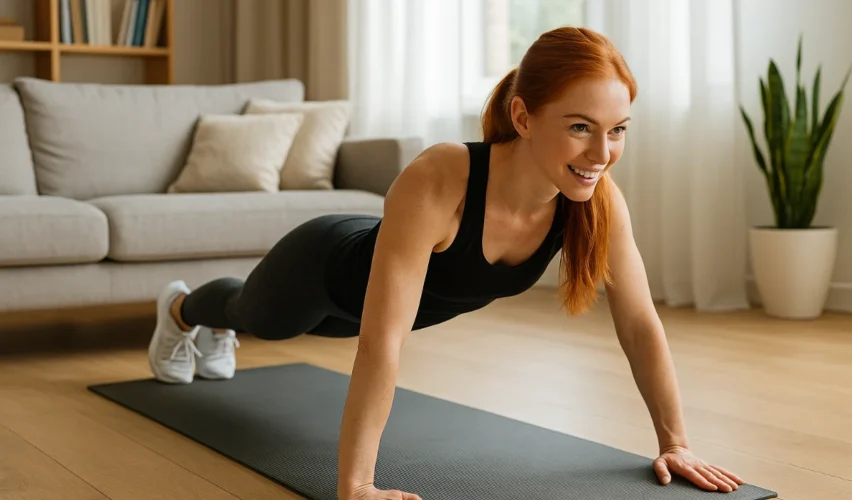
Let’s face it: your home might have a couch, a TV, and maybe that embarrassing pile of gym gear you never use. But the thing most underutilised (that has huge potential) is your own body.
This post is your beginner’s guide to bodyweight workout — no equipment, no gym membership needed — just you, your space, and a few smart tips. Whether you live in Melbourne, Brisbane, Adelaide or a quiet Aussie coastal town, you can start building strength right where you are.
Quick Overview: Snapshot Summary
- Bodyweight workouts use your own body as resistance — they’re practical, flexible, and scalable.
- With smart progressions, you can build strength, endurance and mobility (sometimes even comparable to weights) (Rumen)
- Key beginner moves: push-ups (or modified), squats, planks, lunges, glute bridges.
- Use progression tools: leverage, tempo, reps, variations.
- This post is your bodyweight workout bootstrap — pick a few exercises, try the quiz, and build habit.
Want to dig into design, sample programs, cues and FAQs? Keep reading!
Why Bodyweight Workouts Are a Great Starting Point
Before we jump into routines, let’s talk about why bodyweight training is worth your time — especially as a beginner.
Benefits include:
- Accessibility & cost-effectiveness
No equipment needed. Your body is your gym. - Functional strength & movement
You build strength in movement patterns that mirror everyday life. - Scalable & adaptable
Use variations, tempo, or leverage to make exercises harder or easier. - Joint and core engagement
Many bodyweight moves inherently demand stability, balance, core recruitment. - Proven results
Studies show that well-designed bodyweight programs can stimulate strength and endurance gains comparable to weight training when correctly structured. (Rumen) - Flexibility for constraints
Whether you’re traveling or stuck at home, bodyweight workouts are viable.
Did You Know?
The rise in home and bodyweight training was accelerated during the COVID era, with many people turning to minimal or no-equipment regimes. (ResearchGate)
Laying the Foundation: Key Principles & Safety
As a beginner, it’s crucial not to rush. Good foundations lead to longevity — bad form leads to injuries.
1. Quality over quantity
Start with smaller reps, focus on correct movement, controlled tempo.
2. Progressive overload, just differently
You don’t add plates — you change leverage, pause longer, slow down, reduce support, etc.
3. Rest & recovery
Your muscles need at least 48 hours to recover before hitting the same group again. (Australia’s health guidelines suggest strength/resistance work at least twice per week) (Better Health Channel)
4. Warm up & mobilise
Joint mobility, dynamic stretches, light activation (glutes, shoulders) before moving into strength work.
5. Listen to your body
Soreness is OK; sharp pain is not. Adjust or regress exercises if needed.
Core Beginner Bodyweight Exercises & How to Do Them
Below is a selection of beginner-friendly moves. Master these before moving to harder variations.
| Exercise | Description / Tips | Progressions / Variations |
|---|---|---|
| Push-up (or knee push-up) | Hands under shoulders, body straight. Lower with control, push up. | Incline push-up, negative (slow lowering), diamond push-up |
| Bodyweight squat | Feet shoulder-width, chest up, sit down behind hips. | Split squats, single-leg pistols (later) |
| Glute bridge / hip thrust | Lie on back, knees bent, drive hips upward, squeeze glutes. | Single-leg bridge, elevated feet bridge |
| Plank (front and side) | Maintain a neutral spine, core tight, no sagging hips. | Side planks, plank with reach, dynamic plank |
| Lunges / reverse lunges | Step forward (or back), drop until both legs ~90°, control. | Walking lunges, jumping lunges |
| Superman / back extensions | Lie face down, lift chest & arms off floor, squeeze back. | Alternating arm/leg lifts, “swimmers” |
Pro Tip Box
Start with 2–3 exercises per session. As you become more confident, you can structure full-body routines.
How to Build a Simple Bodyweight Program (Beginner Version)
Here’s a sample 3-day per week program for absolute beginners. Use it for 4–6 weeks, then reassess.
| Day | Focus | Example Workout |
|---|---|---|
| Day 1 (Strength Emphasis) | Push, lower body, core | Push-up (knees) 3×8, Squat 3×12, Glute bridge 3×10, Plank 3×20s |
| Day 2 (Active / Mobility / Light Work) | Active recovery + mobility | Walking, dynamic stretches, core activation, light glute work |
| Day 3 (Full-Body) | Mixed push, pull, core | Push (incline or negative) 3×6, Lunges 3×10 each leg, Side planks 3×15s, Superman 3×10 |
Progression tips:
- After you comfortably hit the target reps, increase difficulty (variation, tempo, holds).
- Alternate rest days: avoid doing heavy bodyweight on back-to-back muscle groups.
- Track consistency — more important than intensity early on.
Quick Guide: Overcoming Common Beginner Challenges
Scenario
You’re trying: full of motivation, but after a couple of sessions your arms, legs, or joints ache. You feel like quitting.
Challenges
- You don’t know how to progress
- Discomfort or soreness (without knowing if it’s normal)
- You’re unsure if you’re “doing enough”
How to Solve It
- Scale back volume (reduce sets or reps), focus on form
- Use regressions (e.g. knee push-ups, partial range)
- Manage frequency: rest when needed
- Embrace gradualism — small improvements compound
Why It Works
Pushing too fast leads to burnout or injury. Smart gradual progress keeps you consistent, which is the real key.
Interactive Section: Bodyweight Readiness Quiz
Rate yourself 1–5 (1 = not confident, 5 = very confident) on each:
| Statement | Score |
|---|---|
| I can perform a full push-up with decent form. | |
| I can hold a plank for 30 seconds without sagging. | |
| My knees / joints feel stable in squats or lunges. | |
| I can perform 10 slow glute bridges with full hip drive. | |
| My core feels engaged during movement (not collapsing). |
Interpretation
- 20–25: You’re in great shape to begin a structured program.
- 12–19: You have foundation, but prioritize regressions and control.
- < 12: Start very gently with modified moves, focus on technique.
If you like, I can map you a starting plan based on your scores.
Mistakes Beginners Often Make (And How to Avoid Them)
- Rushing progress — jumping to advanced versions too soon
- Poor form — doing more reps, worse technique
- Skipping warm-ups / cool-downs
- Underestimating recovery — rest is part of training
- Ignoring variation — doing same moves leads to plateaus
FAQs
Q: How many days per week should beginners do bodyweight workouts?
A: 2–3 non-consecutive days is a good start. Even the Better Health guidelines suggest resistance training at least twice a week. (Better Health Channel)
Q: Can bodyweight workouts build real muscle?
A: Yes — when structured right. Proper leverage, variation, tempo, and progression can stimulate hypertrophy. (Rumen)
Q: Why does my body feel sore after just a few sessions?
A: New stimulus + micro-damage = normal soreness (DOMS). If pain is sharp, stop and regress.
Q: Do I need to supplement with weights later?
A: If your goals push toward high-level hypertrophy or maximal strength, weights can help. But bodyweight training can carry you far.
Q: How long before I see results?
A: Many beginners notice improved strength & movement in 4–6 weeks, especially neural adaptation. Visible changes may take longer.
Conclusion
A bodyweight workout is not just an entry level tool — it’s a powerful foundation for strength, mobility, and independence. You don’t need fancy gear or gyms to begin. Focus on mastering movement, gradually increasing difficulty, and staying consistent. Build your confidence, push smartly, and let your body become your most reliable tool.
You can train anytime, anywhere — let your progress be measured by daily habit, not ego.
Disclaimer
This post is for informational and educational purposes only. It is not a substitute for medical, fitness, or professional advice. Always consult with a qualified health, fitness or medical professional before starting a new workout regimen. If you have injuries, joints issues or chronic conditions, adapt or seek personalised guidance.